



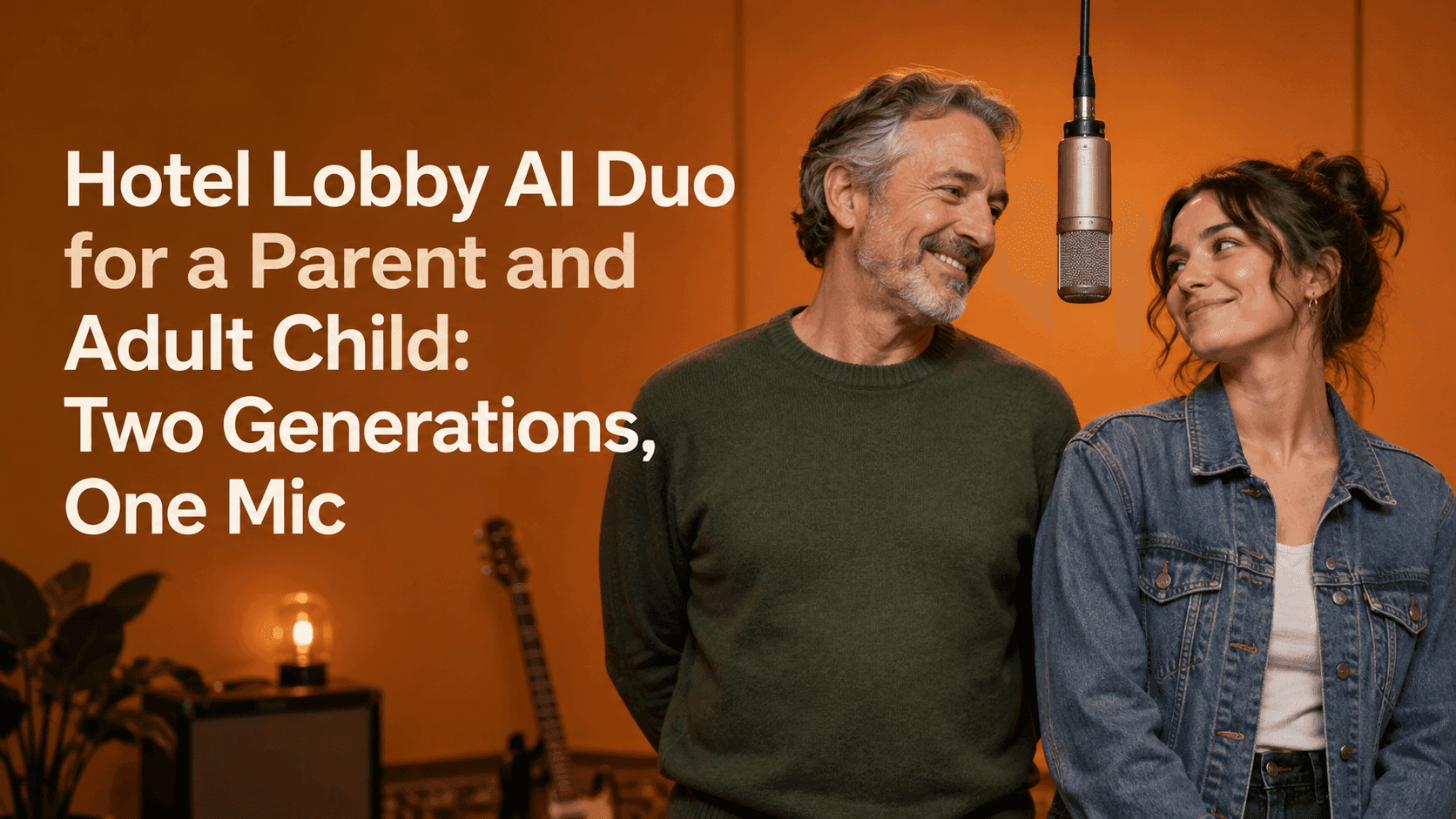
Hotel Lobby AI Duo for a Parent and Adult Child: Two Generations, One Mic
Hotel Lobby AI Duo for a Parent and Adult Child: Two Generations, One Mic
Your parent has a photo they actually like. It is probably not the one you were about to pick. You like the candid shot where they are laughing at dinner; they prefer the one in the blue shirt, standing straight, looking like themselves. For a Hotel Lobby AI Duo, start by asking. Putting a parent and an adult child under one microphone is funny because the pairing is familiar in a setting neither of them would have chosen. The clip works best when both people recognize themselves before anyone reads the caption.
The orange backdrop and hanging mic come from Quavo and Takeoff's HOTEL LOBBY performance on A COLORS SHOW. AI remixes put other pairs into that setup. It isn't footage from a hotel. With a family pair, the joke is seeing two people who disagree over the car radio take turns like a practiced duo.
Hotel Lobby AI Duo begins with two photos they approve
Ask each person for a picture they would be comfortable seeing in motion. Adults have opinions about how they appear online, even when the intended audience is only the family group chat. “It's just a joke” is not much comfort if you chose an unflattering frame.
Choose photos from roughly the same period if the point is you two now. A decade-old picture of a parent beside a new portrait of their child tells a different story. Let the caption carry family history; let the faces be present-day.
The photos need not match perfectly. One can be taken in a garden, the other at a desk. What matters is that both show a clear face, an ordinary expression, and enough of the upper body to make the person feel placed in the performance rather than pasted on top of it.
Don't turn the parent into a stranger
An older face has details worth keeping: a particular smile, glasses worn for years, the shape of the cheeks, a streak of gray hair. Smoothing every line can make the result less kind, not more. You are making a clip with your parent, not auditioning a younger substitute for them.
Watch out for strong filters on the adult child's photo, too. If one face has natural texture and the other looks airbrushed, the pair can feel as though they came from different worlds. Aim for similarly clear, straightforward images rather than similarly glamorous ones.
If the parent wears glasses every day, keep them in the photo—but find a shot without glare over the eyes. The same goes for a familiar hat or hairstyle: keep the detail unless it hides half the face.
One mic needs room for two
The hanging microphone is the center of the scene. When you imagine the finished clip, give both people room around the head and shoulders. A selfie cropped at the chin may look fine as a profile picture; next to a second performer, it can make one person seem much larger than the other.
Put the candidates side by side on your phone. Were the faces photographed from a similar height? Can you see both sets of eyes without zooming? A low-angle portrait beside a high-angle selfie may look mismatched before the video even moves.
Don't choose a group photo and hope the tool knows which two people you mean. Use clear individual images if the template asks for separate uploads. Check the fields on Reveedo's Hotel Lobby video template before you begin; the options shown there are the ones to follow.
Let the contrast do the talking
The best family version usually has one small, true contrast. Maybe the parent is always the reserved one, and the child is always talking. Maybe it's the other way around. You don't need to manufacture a dramatic backstory or dress them alike. Seeing their familiar expressions in an unexpected performance space is enough.
A caption can be as plain as “Mum said she'd never be in one of my videos.” It gives the viewer the relationship and the joke without pretending the two recorded a song.
Avoid captions that make the parent the butt of the joke simply for being older. The funnier angle is often that they look more at home with the mic than their grown child does. In a Hotel Lobby AI Duo, both people should get to be in on it.
Check both people, not just the louder one
When the render is ready, watch it once without stopping. Then watch again for the quiet performer. In a two-person clip, it's easy to focus on whoever appears to have the line while the other person's face drifts or their hands change shape.
Pause when each person turns toward the mic. Do their jawlines and glasses stay recognizable? Does one person's hairstyle jump between frames? Can you still tell them apart when they stand close together? A little motion softness is normal; a face becoming someone else is not.
If one person looks wrong, change only that person's photo. You'll learn more than you would from rebuilding the whole video at once.
Send it to them before the internet
Show the finished version to your parent before posting it publicly. They may love the family-chat version and prefer to keep it there. Your adult child may feel the same. Consent for a photo is not automatically consent for an animated, shareable performance.
When you do post, label it as an AI-made remix. The original COLORS performance involved real artists and a real production; your family clip is a playful imitation, not part of that performance. Check the audio available on the platform where you publish rather than assuming any soundtrack can be reused everywhere.
The point is not to make two generations look identical. It is to let them share the same improbable few seconds without losing who either person is. Pick photos both of them would choose, leave their familiar details alone, and let the microphone sit between them. That is when a Hotel Lobby AI Duo feels less like a face-swap trick and more like a family joke worth keeping.