



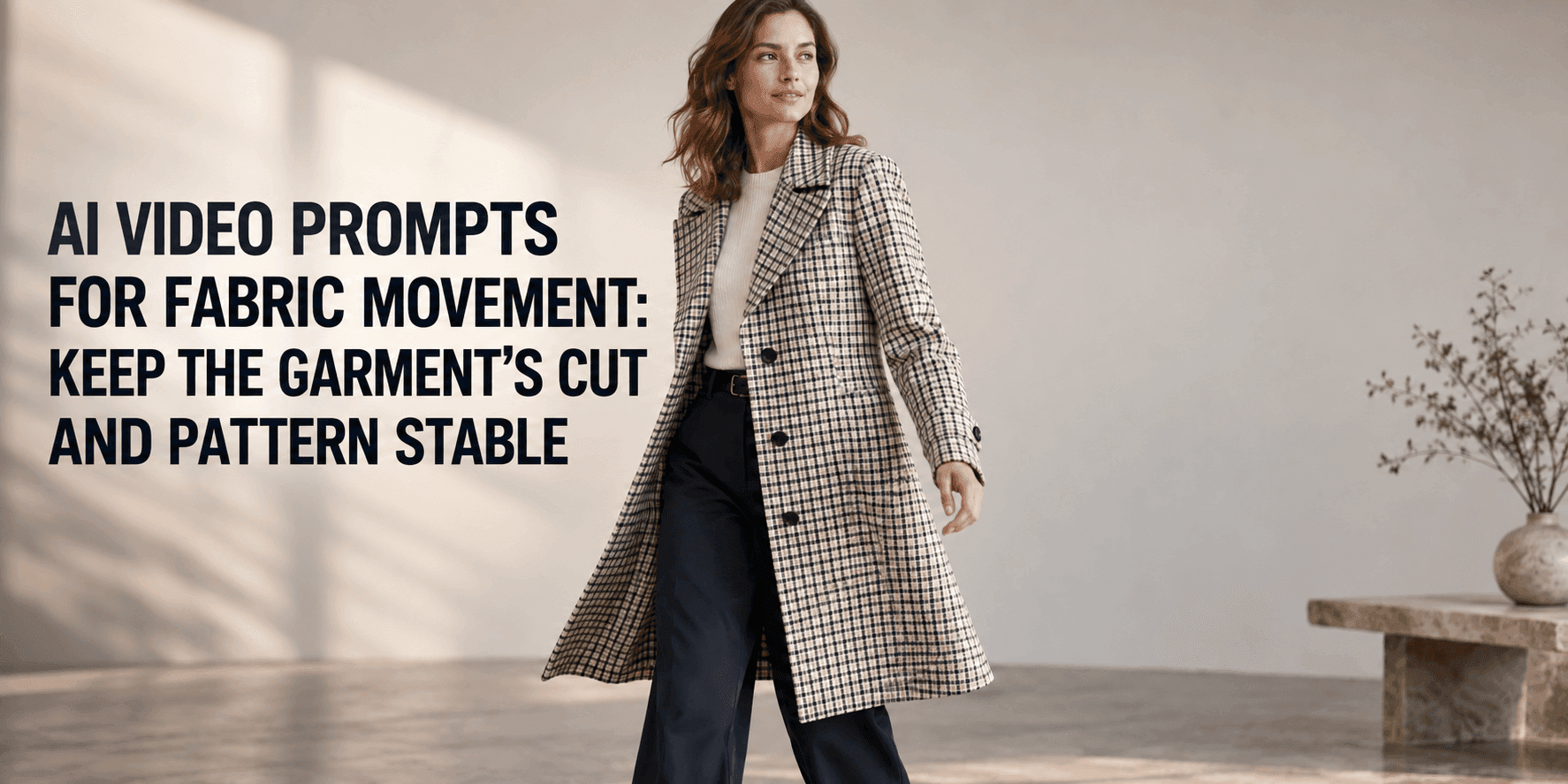
AI Video Prompts for Fabric Movement: Keep the Garment’s Cut and Pattern Stable
AI Video Prompts for Fabric Movement: Keep the Garment’s Cut and Pattern Stable
The first three seconds looked promising. A model in a striped shirt stepped toward the window, and the cuff moved exactly as it should. Then the shirt acquired an extra stripe. By the final frame, the pocket had slipped halfway across the chest. If you have made a clothing clip from a still photo, you have probably seen a version of this. Fabric movement is easy to request and surprisingly hard to contain. A useful prompt has to give the cloth a reason to move while telling the model which details belong to the actual garment.
Plan fabric movement around what the photo shows
Before writing anything, study the source image. Is the hem visible? Can you see both sleeves? Does a hand cover the waistband? A prompt cannot reliably preserve a detail that the photo barely reveals. If the pattern matters, choose an image where its scale and placement are clear. A three-quarter view often works better than a dramatic pose because you can see how the garment hangs.
Make a short inventory: silhouette, neckline, sleeve length, seams, closures, and print. For a plaid coat, the lapels and check spacing may be the distinguishing details. For a plain satin dress, it may be the waist seam and the way the fabric catches light. Good fabric movement starts with knowing what you would notice if it changed.
The background matters too. A breeze that lifts a skirt should make sense in the scene. An indoor studio with still hair and curtains offers little support for a strong gust. You can ask for a faint draft, or choose a smaller motion that comes from the wearer’s body. That gives the fabric movement a cause the viewer can understand.
Give the garment one cause of motion
Write the action before describing the cloth. “She takes one slow step” gives the skirt a cause to swing. “He raises his arm to reach a shelf” explains a crease at the elbow. Without that cause, fabric movement can look like an animation laid over the person.
Keep the first test simple. A step, a quarter turn, or a hand brushing the coat is enough. When you combine walking, spinning, wind, and a moving camera, it becomes difficult to tell which instruction changed the shirt. It also gives the model more chances to invent an unseen side of the garment.
The order of events helps. Describe a beginning, a response, and an end: “She turns slightly; the loose sleeve swings behind the wrist; the sleeve settles when she stops.” That final pause gives fabric movement a believable rhythm. Constant fluttering is rarely how a heavy jacket or fitted blouse behaves.
Use verbs with a scale you can picture. “Lifts a little,” “swings once,” and “settles against the leg” are clearer than “flows beautifully.” You are giving stage directions, not writing an advertisement for the fabric.
Keep the cut in the sentence, not just the reference
If the garment has a feature you care about, name it where you describe the action. Consider a cropped jacket with a square shoulder and two front pockets. As the wearer turns, ask the hem to shift slightly while the cropped length, shoulder shape, and pockets stay in place. The model then has a description of the jacket as well as a picture of it.
This matters when fabric movement reveals or hides an edge. A coat opening can expose its lining, but the front panels should not grow wider. A skirt can lift at the side without becoming shorter all the way around. A sleeve can bunch at the elbow without turning into a different sleeve.
Avoid asking for zero change. Cloth bends. Stripes curve around folds and highlights move across silk. The useful constraint is continuity: the same garment is present before, during, and after the action. That leaves room for physical motion while keeping the design recognizable.
For a simple prompt, try: “The person makes a gentle quarter turn. The coat hem swings once and falls back. Preserve the original knee length, straight cut, wide lapels, two buttons, and narrow pinstripes throughout.” The fabric movement is small, but the garment remains identifiable.
Watch the pattern as closely as the outline
A print is attached to the cloth. It should follow a fold, not slide across the surface. On a striped shirt, look at the stripe nearest the pocket as the torso turns. Does it stay beside the pocket, or does it cross over it? On a floral dress, check whether a flower reappears in a different place after a ripple. These are easier faults to spot than a vague sense that the clip looks wrong.
In prompts for fabric movement, describe the relationship between the print and the garment: “The gingham pattern bends with the folds; its colors, check size, and placement remain consistent.” If there is a logo, give its location. “Small white logo on the left chest” is more useful than “keep the logo.” Buttons, embroidery, and contrast stitching deserve the same treatment when they are visible and important.
Be selective. Listing every possible flaw can bury the shot under warnings. Pick two or three features a viewer would recognize instantly. A single clear sentence about them often does more than a long negative prompt.
Match the motion to the material
A sheer scarf can float after the wearer stops. Denim usually cannot. A linen shirt tends to form angular creases; a soft knit gathers differently. You do not need perfect textile terminology, but the material should influence the size and speed of the action.
For linen, ask for creasing at a bent elbow and a small shift at the waist. For a pleated skirt, let the pleats fan slightly during a step, then return to their original spacing. For a structured blazer, keep the shoulders firm and limit fabric movement to the lower panels. These concrete descriptions help a clip feel filmed rather than loosely imagined.
Lighting is part of the test. On shiny fabric, a changing highlight may make the material appear to change color or texture. Ask for steady light and a fixed exposure during the first generation. Once the fabric movement behaves, you can experiment with a more expressive camera or lighting setup.
Keep the camera quiet for the first pass
A camera orbit introduces new views of seams, pockets, and the far side of the garment. If those areas are not visible in the source photo, the model has to invent them. Start with a locked camera or a very slow push. Keep the wearer large enough in frame to inspect the clothing, but leave room for the hem or sleeves to move.
When testing fabric movement with Reveedo, begin with a short image-to-video clip and one modest body action. Watch it at normal speed, then replay the moments around the turn or step. If the cut holds, try a second version with a little more motion. Changing one thing at a time makes the result easier to judge.
A fast camera move can make an error seem like motion blur. That may look acceptable on a phone screen, then become obvious when you pause the clip for a product page. Check at least one still frame near the middle and another near the end.
A prompt you can adapt
A model wearing a cream blouse with a small blue floral print stands near a window. She turns a quarter circle toward the light and pauses. The blouse shifts naturally at the waist; the sleeves form soft creases at the elbows and settle as she stops. Keep the original neckline, sleeve length, buttons, waist fit, and floral placement consistent. The flowers follow the folds without changing size or moving to new areas. Fixed medium shot, steady daylight, no added wind.
The wording is plain on purpose. It identifies the garment, gives one action, explains the fabric movement, and anchors the details likely to drift. To use it for another item, replace the garment inventory and the cause of motion. A pleated skirt needs different instructions from a blouse; a leather bag strap needs a different response again.
If the first clip fails, do not rewrite the entire prompt. Shorten the turn if the far side is invented. Reduce the breeze if the silhouette balloons. Name the wandering print feature more precisely. Fabric movement usually improves through a few small corrections that address visible mistakes.
The best result may be quieter than you expected. A cuff that drops back onto a wrist, a hem that moves with one step, or a fold that catches the light for a moment is enough to make a still photograph feel alive. When fabric movement follows the body and the garment keeps its identity, the video has done its job.