



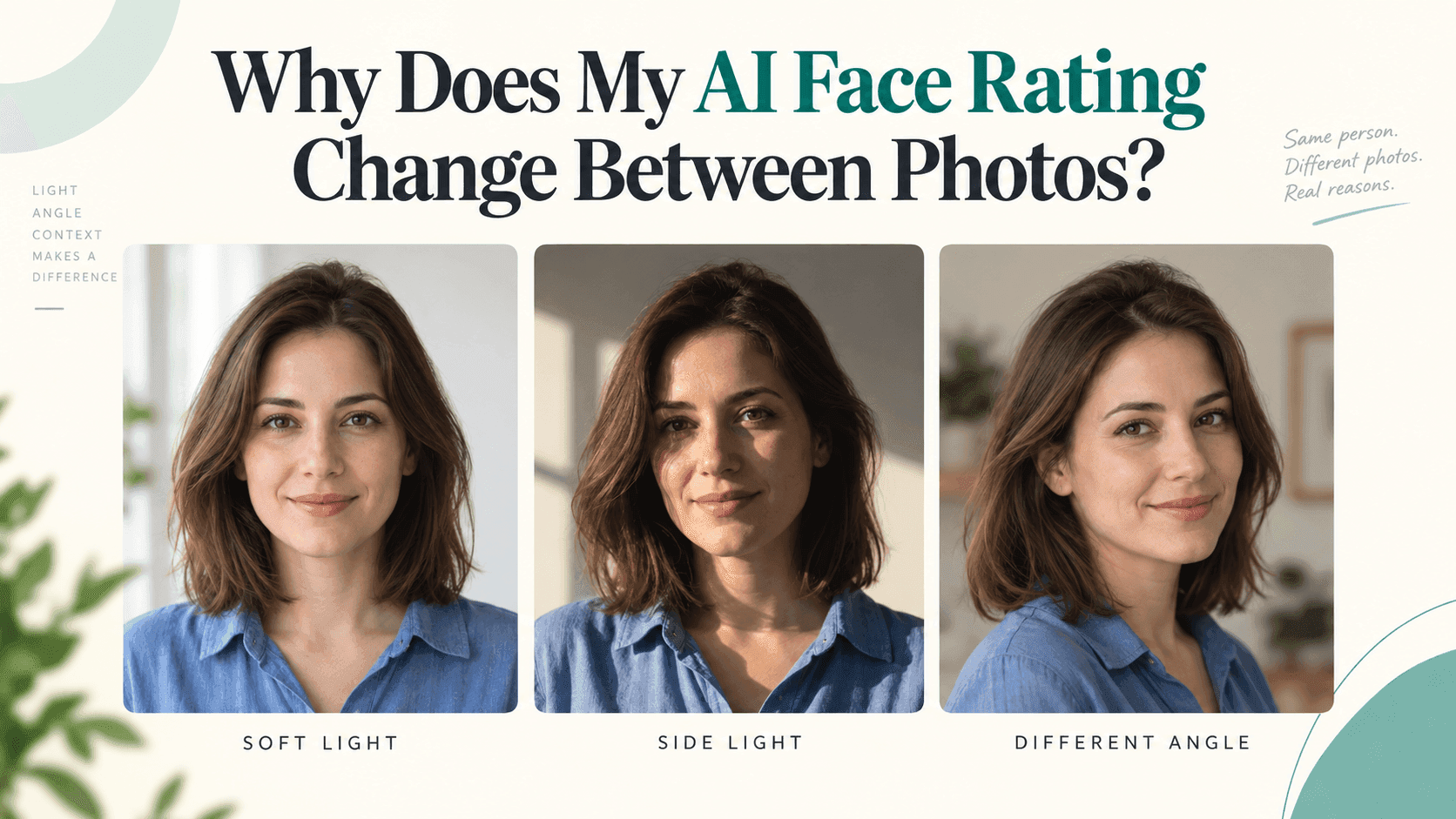
AI Face Rating: Why Your Score Changes Between Photos
Why Does My AI Face Rating Change Between Photos?
You upload a selfie, check the result, then try another picture taken that same afternoon. The number changes. You are wearing the same clothes and have not changed anything about your appearance, so which result are you supposed to believe?
An AI Face Rating responds to the photograph you submit, using a particular system's scoring method. Different photos are different inputs. A changed score does not, by itself, show that you became more or less attractive.
The useful question is what changed between the images, and how much you actually know about the tool.
Your AI Face Rating Starts with a Photograph
A photo does not show your face independently of the camera. It shows one view, under particular lighting, with a particular expression and amount of detail.
Compare a close selfie with a portrait taken from farther away. The perspective is different. Turn your head, and parts of your face become less visible. Smile, and the visible shapes around your eyes, cheeks, and mouth change.
Those differences give an AI Face Rating system different material to process. Exactly which changes affect its score, and in which direction, depends on the service. Without published information or controlled testing, you cannot assign a precise cause to a particular result.
This also means the higher AI Face Rating is not automatically the “correct” one. Choosing the number you prefer does not establish its accuracy.
The Lighting Changed More Than You Noticed
A window portrait and a restaurant selfie may show the same expression, but the light can make them look quite different. A dark shadow may hide one cheek; a bright reflection may obscure an eye behind glasses.
Before comparing an AI Face Rating, look at the photos themselves. Are the same details visible in both?
NIST's face-image quality work evaluates factors including pose, illumination, and resolution in relation to face recognition. That research concerns recognition performance, not attractiveness scoring, and does not validate beauty ratings.
It does explain why image conditions deserve attention. For an AI Face Rating comparison, clearer lighting reduces one source of uncertainty about the input. It does not turn a subjective score into an objective measurement.
There is no universal rule that brighter light earns more points. Overexposure can hide details too.
Filters, Expressions, and Crops Complicate the Comparison
Check whether one image has been edited. A beauty filter may reshape features, smooth skin, or alter proportions. Your AI Face Rating then concerns that edited photograph, not an untouched reference.
Automatic camera processing is worth checking as well. Two apps can produce visibly different pictures without you deliberately choosing a filter.
A broad laugh and a neutral expression also show different facial configurations. Neither needs to be treated as your one “real” appearance.
For an AI Face Rating comparison, avoid changing everything together. If one photo is filtered, tilted, tightly cropped, and taken in different light, the score alone cannot tell you which difference mattered.
Cropping may also change what reaches the tool. Some services locate and crop faces themselves; others may handle uploads differently. Do not assume every AI Face Rating service uses the same preparation process.
What If the Exact Same File Gets Different Results?
That is a different question from comparing two photos.
If an AI Face Rating changes for an identical file, image differences cannot fully explain it. Possible explanations include variable model output, changed settings, or a service update. These are possibilities, not a diagnosis of a particular platform.
Check that you used the same file, tool, and mode. Keep a note of the date and result if you want to ask the provider about the discrepancy.
Do not automatically average several AI Face Rating results and call that your true score. Repetition may reveal inconsistency; it does not establish that the underlying rating measures attractiveness accurately.
Scores from different websites are another comparison entirely. Even when both use a ten-point scale, their criteria may differ, so matching numbers need not mean matching judgments.
A More Useful Way to Compare Two Photos
If you remain curious, choose one clear, unfiltered portrait as a reference. Compare it with one other photo while keeping the pose, expression, and camera distance reasonably similar.
Note the difference you intended to examine. If the AI Face Rating changes, describe the observation narrowly: the tool returned a different result for these images. One comparison cannot prove a general rule about lighting or faces.
You can find the face-score feature through Reveedo. Read the current instructions and privacy information before submitting an AI Face Rating photo, and use images you have permission to upload.
Treat the exercise as a look at how a tool responds to photographs. If checking your AI Face Rating becomes a search for reassurance, you can stop.
The photo you love may capture a laugh, a memory, or a version of yourself that feels familiar. An AI Face Rating does not decide whether that picture is worth keeping.